Thursday, 31 January 2013

Thank you!!

Well I'm really sad to say it but, it's time for me to say goodbye to you all and write my final blog entry.

I admit that when I first started writing, I was very nervous about the reception it would get and what direction my blog would go. But after a few posts, I felt more at ease and trust that you found it easy, straightforward and exciting to read. Writing it has definitely taught me a huge amount, not just about alien species but also about my own opinions on climate change and extinction. Before, I had never even thought about the possibility of  human's becoming extinct in the future!

Anyway, enough about me, I hope that from this blog I have taught you a few new facts about invasive alien species, including their effects on global biodiversity, how natural and anthropogenic forces are affecting their spread, how the extinction rates will be effected in the future, that not all alien species are negative and most importantly, that wallaby's reside in the UK.
I have tried to cover a wide range of topics and issues affecting non-native invasive species, as well as their economic and political effects on humans.
Hopefully by writing this blog I have succeeded at my main aim and inspired a few of you to look further into some of the topics surrounding alien species. Perhaps, maybe even motivated you to download or even use the PlantTracker App? (or is that a bit too far fetched?)

Thank you all for having followed my blog, it's been a great pleasure writing for you! I shall definitely be back soon!

I will leave you with this...


Tuesday, 29 January 2013

Aliens Banned

Yesterday, for the forest time in English history, the UK government decided to ban the sale of five non-native invasive aquatic plants (better late than never I suppose?)

Parrot's feather
(Myriophyllum aquaticum)
The plants which have been banned are:
  • water fern
  • parrot's feather
  • floating pennywort
  • water primrose
  • Australian swamp stonecrop

(The plants highlighted in blue are all species found on the PlantTracker App)


The ban is due to come into force in April 2014.

DEFRA have said that the plants listed in the ban were chosen as they were overwhelming native species and were causing significant environmental and economic harm. As these plants had no natural controls in the wild, they were able to grow rapidly and form dense mats on the surface of rivers and lakes. Leading to the decline of other aquatic species in these waterways as the amount of dissolved oxygen is lowered. These mats also increased the risk of flooding (NNSS). 

I believe this is a step in the right direction to tackle the UK's invasive species problem.

However is it too little, too late? We shall have to wait and see!

Tuesday, 15 January 2013

Zebra Mussel Continued...

I have posted a short 2 minute video showing the effects of zebra mussels in the Great Lakes.

Give it quick watch and enjoy the music!!


Monday, 14 January 2013

Alien Species of the Week-Zebra Mussel (Economic Impacts)


Zebra Mussel (Dreissena polymorpha)

One invasive species which really caught my eye due to the rapidity of its spread and its potentially catastrophic impact on the freshwater ecosystems of North America, is the much maligned Zebra Mussel (Dreissenapolymorpha).

Zebra Mussels
(Dreissena polymorpha)

This small mollusc, averaging at around 2cm in length, is named as such because of the striped brown and yellow pattern on its shell. Native to Western Russia and the Black Sea area, they were transported to the Great Lakes region of North America via ships during the mid 1980s, with the first colonies being discovered in 1988 (Griffiths et al. 2011).

In this new environment relatively free of natural predators, its females capable of producing 100,000- 500,000 eggs per year, its population has exploded. With its ability to attach itself to hard objects (any object dropped in the water) and the long survivability of its larvae in water, it has since been able to rapidly spread to the Mississippi, its tributaries and surrounding lakes (Ricciardi et al. 2002).


Map showing the spread of the zebra mussel across the United States

The ecological impact of the mussel has been severe!! While their voracious filter feeding and breeding has greatly improved water clarity in lakes and rivers, they have also depleted the availability of microscopic organisms that play a critical part of the lake and river ecosystems. Indeed, fish numbers and biodiversity has decreased as juvenile and larval fish are starved of their main food (Maclsaac et al. 1992). Moreover, the Zebra mussels can also attach themselves to native mussels, killing them, which has resulted in the sharp decrease in native mussel numbers.

Their economic impact has been no less severe. Fisherman consistently have their lines destroyed by underwater Zebras, the future of commercial fish breeding in the Great Lakes region is at risk. They have also caused major problems for power and water treatment plants located by the lake shores – frequently clogging their water cooling intakes (Griffiths et al. 2011). 

The severity of the Zebra mussel threat to local ecosystem and their economic impact have been recognised by the Canadian and US government, as well as local government, which continue to devise plans to slow its spread.

Nevertheless, relentless conquest of North America seems unstoppable!!

Thursday, 3 January 2013

King Crab and the Palmer Deep

King Crab (Neolithodes yaldwyni)


While scouring the internet in search of some interesting invasive species to showcase, I came across an article published in the biological research journal ‘Proceedings B’ (The Royal Society)  regarding the recent discovery of a species of deep-sea King Crab (Neolithodes yaldwyni) in Palmer Deep, a basin cut into the Antarctic continental shelf.  


King Crab
(Neolithodes yaldwyni)
The population of crabs are estimated to be up to 1.5 million, at a population density of 10 600 km2, living at the depth of 850m. What is remarkable about this discovery is that these Lithodid crabs are thought to have been excluded from the arctic continental shelf waters for more than 14 million years due to their intolerance of water colder than 1.4C.  The crabs are thought to have crossed the Antarctic shelf to reach Palmer Deep.


With the warming of the oceans, it had been hypothesised that the fragile Antarctic ecosystem was at risk from future lithodid invasion. Nevertheless, this discovery has come as a surprise and indicated that the waters of the west Antarctic Peninsula are warming faster than previously thought. Indeed, the warming of the Antarctic waters has allowed these predators to establish themselves in this challenging environment (National Geographic).


While currently confined to dwelling at a depth of 850m, it is estimated that the peninsula shelf waters are warming at approximately 0.01°C yr−1. The project leader of the team which discovered the crab colony, Professor Craig Smith of the University of Hawaii, told the BBC that that the species could spread up onto the shelf itself, to shallower depths, within the next decade or two.


Should the crabs spread to shallower waters, their impact on the ecosystem would be devastating. Not only do many of the native species – from brittle stars, urchins to sea lilies – not have resistance to the predatory crabs after 14 million years of isolation, but the crab has been termed an “ecosystem engineer” digging deep into soft sediments, preying on seafloor animals and altering basic habitat structure at the ocean bottom. Immediately above the 850m crab dwelling zone, the researchers found very few of the creatures they would have expected to have been in abundance at 50-100m depth. 

Perhaps this is a only a taste of what is to come?

Wednesday, 2 January 2013

Benefits of Invasive Species

There is a general belief that invasive species are inherently harmful to natural ecosystems. Up until now, most of my blog posts have solely focused upon the negative effects of invasive species. So instead I am going to change my attitude and look on the bright side of alien species.
For where there is a negative, surely there is always a positive? 

In certain cases, alien species are actually quite beneficial and can be both economically and ecologically advantageous. Many invasive species serve important but under appreciated roles such as providing desirable ecosystem services, replenishing human-damaged regions, serving as functional substitutes for extinct taxa and providing habitat or food resources to rare species (Schlaepfer et al. 2011). 

Catbird in a Honeysuckle
Scientists from Penn State University looked at the role of mutalism in determining the success of an invasive species. Gleditsch and Carlo (2010) discovered that since the introduction of the non-native honeysuckle plant to Central Pennsylvania, the number of fruit-eating birds e.g. robins, catbirds in the area has grown four folds. The honeysuckle and bird communities have formed a mutualistic relationship. 

The honeysuckle comprises more than half of all the fruits available in the landscape so acts as a main source of food to the birds.  In return, the birds benefit honeysuckle by dispersing the plant's seeds across a wider geographical area, mainly in territories already affected by human activities.

Thus, if honeysuckle were to now be removed from this ecosystem, it would almost certainly harm many native bird species whom rely on honeysuckle as their major food source. 
 In the Hawaiian rainforest, non-native species of birds are now the primary dispersers of seeds and fruits of some native plant species as a result of native birds having become extinct (Foster & Robinson 2007).

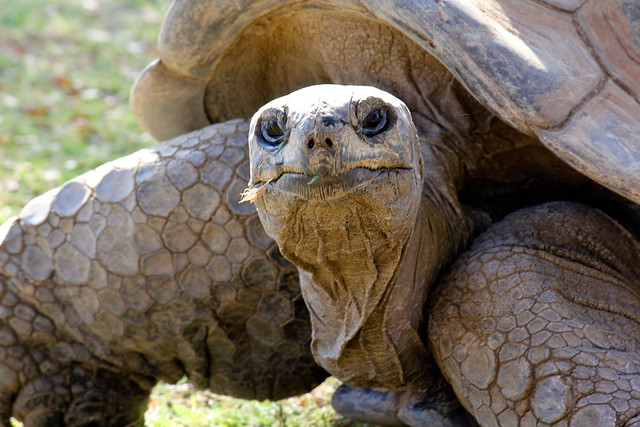
Furthermore, non-native species can also act as a catalyst for ecosystem restoration. For example, in Puerto Rico, former pastures with sparse vegetation and eroded soils are not readily recolonized by native trees. By contrast, non-native plantation trees are able to survive and so attract seed dispersers (Parrotta 1999). Sometime, non-native species are deliberately introduced to fill an ecological niche formerly occupied by a closely related species like on the islands of Mauritius. The Aldabra giant tortoises (Aldabrachelys gigantea) was introduced onto a few small islands, where they have successfully replaced the seed-dispersal functions of extinct native tortoises (Griffiths et al. 2010). 


Aldabra Giant Tortoise
(Aldabrachelys gigantea)


I have only scratched the surface of the numerous benefits invasive alien species can provide. Among the articles and papers I have read it appears that a bias persists against non-native species amongst the scientific community. Non-native species can cause the loss of biological diversity but as discussed they can provide wide ranging conservation benefits. 

In the future, invasive species could fill niches in degraded ecosystems and help restore native biodiversity in an inexpensive and self-organized way that requires little or no human intervention (Gleditsch and Carlo 2010).


Monday, 17 December 2012

Alien Species of the Week-Chinese Mitten Crab

Chinese Mitten Crab (Eriochier sinensis) 

The Chinese Mitten Crab originates from the Yellow Sea region, along the border with China and Korea. It was first recorded in Europe in the early XX century and is now common in Europe as well as in North America (Dittel and Epifanio 2009). Eriochier sinensis first appeared in the UK in 1935 (Thames river) but became firmly established in 1975 (Veilleux and de Lafontaine 2007).


Chinese Mitten Crab (Eriochier sinensis)
Its omnivorous nature makes the Chinese Mitten Crab a threat to local ecosystems due to its consumption of native species such as fish larvae, algae, detritus and a variety of macro invertebrates and aquatic plants.

As a result of its burrowing activity, the Eriochier sinensis is also a cause of river bank erosion and collapse. The economic impact of this alien specie in Germany, since its appearance in 1912, is estimated at around 80 billion euros (Global Invasive Species Database).


Cohen and Carlton (1997) (cited in Veilleux & de Lafontaine, 2007) identified 10 pathways that would account for the worldwide spread of the Chinese Mitten Crab:

  • ƒ dispersal of larvae by currents 
  • ƒ passive dispersal of adults or juveniles on floating material 
  • ƒ transport of adults or juveniles by ship fouling 
  • ƒ transport of adults or juveniles in cargo 
  • ƒ transport of adults or juveniles on  semi-submersible drilling platforms, 
  • barges and other long-distance slow-moving vessels 
  • ƒ transport of larvae or juveniles in ballast water 
  • ƒ transport of adults or juveniles in fisheries products 
  • ƒ transport of larvae in water with shipments of live fish 
  • ƒ escape or release from research, public, or private aquaria 
  • ƒ intentional transfer to develop a food resource

General distribution of mitten crab Eriocheir sinensis populations in their native and invasive ranges.Circles correspond to established (Image) and non established populations (Image) in non-native range; (Image) indicates distribution in the native range.
(from Dittel & Epifanio, 2009)


So far the eradication measures such as the physical trapping of the crabs has not proven successful.

Check out this video:

Philine zu Ermgassen, Freshwater Ecologist at the University of Cambridge, talks about its identification, impacts and management in Great Britain:


Further reading on the spread of Eriochier sinensis:

NOBANIS –Invasive Alien Species Fact Sheet

DAISIE - Species fact sheet

Natural History Museum - Chinese Mitten Crab page

Wednesday, 12 December 2012

Are we nearing a 6th Mass Extinction?

Having already looked at the impacts of several alien species on their invaded environment, I think is important to examine past and future extinction rates.

So I thought we should delve into the past and examine whether or not we are entering into the Sixth Mass Extinction?

What are Mass Extinctions?

Mass extinctions are defined as the loss of  at least 75% of Earth's species in a geologically short time frame (Jablonski and Chaloner 1994). Palaeontologists recognize five major extinction events ("Big Five") in the past 540 million years, with the most recent mass extinction event ending 65 million years ago-Cretaceous (Barnosky et al. 2011).  The "Big Five" mass extinctions took place near the end of the Ordovician, Devonian, Permian, Triassic and Cretaceous Period . As the number of known species which have become extinct over the past thousand years has risen, biologists suggest that a sixth mass extinction may now be under way.  It is expected that if all species currently deemed "threatened" become extinct in the next century, then future extinction rates will be 10 times recent rates ( Pimm et al.1995)-astonishing!!
Mass Extinctions and CO2 Levels

What are the main causes?

Observations suggest that humans are the main cause of this sixth mass extinction, through habitat fragmentation/ modification, introduction of non-native species, spreading pathogens and killing species directly (Barnosky et al. 2011).  All of these human activities are associated with climate change through global warming due to increasing levels of carbon dioxide, increasing levels of volcanism and ocean acidification. According to the graph above,  all major extinctions occurred when CO2 levels exceeded a thousand parts per million (ppm). Highlighting the important role human's play in determining the speed at which we meet the sixth extinction. 

The graph below, produced by Barnosky et al. (2011), compares extinction rates versus extinction magnitude across different geological time periods. It shows that in the future, if current extinction rates over the last 500 years were to continue it would produce a "Big Five" style magnitude mass extinction. This means that current extinction rates for species are either faster or just as fast as all rates that would have produced the "Big Five" extinctions. 

However, I must point out that you should take CAUTION when comparing extinction rates, as the fossils used and quality of their preservation varies greatly. For example, many of the earlier mass extinctions rates were solely based on marine organisms.

Extinction rates versus extinction magnitude
Today, the current rate of species extinctions has most definitely been enhanced by human activities as CO2 concentration levels increase. Although, recent species loss is definitely serious and dramatic, we can't yet call it a mass extinction. However, the number of species now classed as "critically endangered" suggests that a sixth mass extinction is soon to become a reality.

This makes me question as to what the future holds for us humans and when will we potentially become "extinct"?!?

Monday, 10 December 2012

Power of the App!


http://planttracker.naturelocator.org/sites/default/themes/planttracker/images/logo-planttracker.png 

So far I’ve spoken about some of the difficulties caused by invasive/alien species, but how as a member of the public can we help combat these invasions? 

Well the answer is simply “PlantTracker!"

The Environment Agency, the University of Bristol and the Centre for Ecology and Hydrology have teamed up and developed a FREE app allowing the public to identify some of the UK’s most problematic invasive, non-native plant species. 

The PlantTracker app allows users to very easily identify 14 invasive plant species (e.g. Rhododendron) with the help of an image gallery and a detailed description of each plant species. What is also great about this app is that it also includes a “Confusion Species” gallery, making it easier to distinguish non-native from similar looking indigenous plants. Furthermore, once you have identified one of the invasive plant species using the app, you can submit a geo-located photo of the specimen.


PlantTracker screenshot options


Why an app?

It is crucial to gather solid data to make important decisions on how to manage and deal with the problem of invasive plant species. However, it is usually very difficult collect verifiable and accurate data about the distribution of these invasive plant species. But by combining the smartphone application with the power of crowd-sourcing data collection, the app allows real time and verifiable data to be collected (see below).


Map showing the distribution of Rhododendron reports.
(The red dots indicates the number of verified Rhododendron records)


Where can I get the app?

PlantTracker is available free from the iTunes App Store and Android Market. So go on, why not give it a go and download the app? I’ve already downloaded mine!

Monday, 12 November 2012

Alien Species of the Week: Nomad Jellyfish

Rhopilema Nomadica (Nomad jellyfish)

Originally from the Indo-Pacific, the Nomad jellyfish first made its appearance in the Mediterranean in the 70s via the Suez Canal, while the first mass appearance was registered in 1995 in Mersin Bay, off the coast of Turkey (Öztürk and İşinibilir 2010). 
The large presence of this invasive species in the Mediterranean is a cause of concern for the local populations (due to the particularly bad stings), and also for the tourist industry in the affected areas, such as the Israeli coast. The Rhopilema Nomadica affects fishing as well, as it gets entangled in fishing nets and  also eats fish larvae, causing a decrease in the fish stock (Galil 2007).

Nomad Jellyfish (Rhopilema Nomadica)


Due to its rapid spread, the Rhopilema Nomadica is included in the list of the 100 worst invasive species in Europe within the Delivering Alien Invasive Species Inventories for Europe (DAISIE). Its diffusion is diminishing plankton resources and is being detrimental to fishing, tourism and coastal installations. Seasonal variations in water temperature regimes could help fight the annual occurrence of the nomadic jellyfish, whose presence has been further recorder in 2004 in Malta and the Sicily Channel ( Deidun et al. 2011). 

The discovery of R. Nomadica in Maltese waters is another alarming indication of the increasing warming of the Mediterranean Sea as a result of climate change. Among the proposed preventative measures is a salinity barrier in the Suez Canal in order to reduce the number of Red Sea aliens in the Mediterranean.

Will R. Nomadica spread as north as the Ionian Sea and further north along the Italian coasts?

Watch this very short video below to see for yourself how jellyfish are threatening Israeli Power Plants: It's quite astonishing!!


Friday, 9 November 2012

Mosquitoes on the Move as Climate Changes


As already hinted from my previous post, I will be looking at mosquitoes!

Most of us, have at least once in our lives been bitten by one or more mosquitoes. We all know that mosquito bites are itchy and are rather uncomfortable when trying to sleep. Although, the effects of these bites are unpleasant, we never expect these bites to cause us any serious harm or severe illness in Europe. However, scientists have warned that the number of harmful diseased mosquitoes spreading across the European continent is on the rise bringing new public health surprises!

Asian Tiger Mosquito
(Aedes albopictus)
In Europe, the Asian Tiger mosquito (Aedes albopictus) is an invasive species that has the potential to transmit infectious diseases such as dengue and chikungunya fever. The mosquito is native to the tropical and sub-tropical areas of Southeast Asia (Caminade et al.2012). 
However, over the last couple of decades, owing to increasing international travel and the global transport of goods, the Asian Tiger mosquito has invaded many countries around the world and has been ranked as one of the “World’s Worst” invaders by the  Global Invasive Species Database. 
These mosquitoes have the ability to out compete and completely eradicate other species with similar breeding habitats, as they lay drought-resistant eggs (Benedict et al. 2007). This is what makes this invasive species so dangerous!

As well as many other incidents, the Asian tiger mosquito was responsible for the outbreak of Chikungunya fever that occurred in the Italian province of Ravenna, summer 2007 (Enserink 2007). More than 200 people were infected with the disease (ECDC 2007). Scientists have investigated these recent outbreaks and have related them to the wetter and warmer climate patterns over central Europe (Gould et al. 2010). 
The map below shows the known distribution of the Asian tiger mosquito in 2011.

Known distribution of A. albopictus based on field observations from the ECDC/VBORNET
project (December 2011)

So what impact will our warming climate have on the spread of infectious disease carrying mosquitoes?

Through the use of regional climate model scenarios for the future and high-resolution observations, scientists from the University of Liverpool have investigated the suitability of Europe for A. albopictus by using both recent and future climate conditions (Caminade et al. 2012). The results showed that during the 1960-80s, northern coasts of Spain, Italy and southern France were climatically suitable areas for the establishment of these mosquitoes. The main finding of the study showed that over the last two decades climate conditions have become more suitable for the mosquitoes over central northwestern Europe and the Balkans, whilst they have become less suitable in southern Spain and areas around the Mediterranean basin (Caminade et al. 2012). 
Future trends show a similar pattern with climate suitability for mosquitoes increasing over northern Europe (including southern UK) as winters become warmer and wetter. In contrast, conditions appear to become more unsuitable over southern European countries such as Spain and Portugal, as more droughts are predicted in these areas in the future (see figure below).  


 http://171.66.127.193/content/9/75/2708.full.pdf+html. The left column depicts the mean suit- ability based on the ensemble mean of all RCM-driven projections for 2030–2050. The right column shows the future changes (2030–2050) with respect to the 1990–2009 climatology.
 
Several other studies modelling and mapping the distribution and survival of Asian tiger mosquitoes across Europe, such as those carried out by Fischer et al. (2011) and Medlock et al. (2006), show similar distribution trends across Europe. Large areas of western and central Europe that are inappropriate for the species today are projected to change during the 21st century towards a climate that can support the survival of the species.

Thus, climate change is affecting the distribution of mosquito populations and thus the spread of infectious diseases across Europe. It is clear that in the future, unintended anthropogenic introduction can be expected as a constant source of insecurity. European health officials must be prepared and ready to tackle future epidemics of vectorborne and waterborne infectious diseases.

Climate change will have enormous implications for human health in the future.

Further Reading:
Is Climate Change Aiding the Spread of Disease?

Thursday, 8 November 2012

Sorry!

I just wanted to excuse myself for my lack of blog posts over the last week and a half. Having caught the dreaded flu over a week ago, I have only just recovered! However, being ill has inspired one of my next blog posts-here's a clue...


Snake Plague

Having received my new issue of Geographical today, I read a short article that stirred my interest. The article was about the dramatic increase in spider population on the Pacific island of Guam. What was fascinating was that the single accidental introduction of the brown tree snake 60 years ago, managed to wipe out 12 species of native bird. As a result, the island lost almost all its insect-eating birds allowing spider populations to thrive (Rogers et al. 2012).
Brown tree snake

I don't know about you, but I find it astonishing how a few snakes can eliminate almost an entire islands indigenous bird population in such a short space of time?
I suppose, Guam can be described as a text book example of what alien invasive species can inflict on an ecosystem. When the snakes were first introduced to Guam, the indigenous birds did not fear snakes and there were no predators to maintain the snake population. The island was a snake "paradise".

I delved further into the snake situation and discovered that there are an estimated 3,000 brown tree snakes per square mile on the 30 mile long island (National Geographic 2012).

A new research paper published in PLOS ONE (an open access paper, yay!) is one of the first papers to examine the impact of bird loss on the scale of an entire forests. Biologists from the University of Washington, Rice University and the University of Guam, lead by Haldre Rogers,  compared the density of spiders webs on Guam with the density of webs on the nearby Marianas Islands. They discovered that Guam has 40 times more spiders than any of the surrounding islands! Such astonishing results highlight how previous, small-scale studies underestimated the impact of bird loss on spider density as demonstrated by Guam- a large-scale natural experiment.

http://www.plosone.org/article/info:doi/10.1371/journal.pone.0043446?imageURI=info:doi/10.1371/journal.pone.0043446.g001
           Map of the Mariana Islands

(All forest birds are functionally extinct on the island of Guam, whereas relatively healthy bird populations remain on three nearby islands of Saipan, Tinian and Rota.)
   

It seems unbelievable that the effect of one invasive species can change the way in which biologists study and understand alien species interaction with ecosystems.  

So if you have arachnophobia I would not recommend a holiday to Guam!